New York Times Extra Serving Bread Arts Craft Germany Nazi Camp
Richard Neutra's Lovell Health House (1929) and David Alfaro Siqueiros's mural "América Tropical" (1932) are two of the most famous, and arguably virtually influential, modern artworks created in Los Angeles in the last century. Less well-known is the fact that the man who helped Neutra spread his ideas and who commissioned "América Tropical" was none other than L.A.'southward "Nazi Propagandist No. 1."
Let'southward pause a moment here to take in the ideological dissonance. Built by a Jewish architect, the Lovell House would inspire generations of modern homes including, via Neutra's apprentice Gregory Ain (also Jewish), designs focused on improving the lives of regular people. Painted by a communist who fought fascists in the Spanish Civil War, "América Tropical" is a monumental anti-imperialist statement that, despite being whitewashed, has inspired generations of muralists to make public art in pursuit of social justice.
What possible place did a Nazi have in that milieu? How did such alliances occur? And who on globe was Ferenz?
Born in Vienna, Republic of austria, in 1889, Francis Kotausek emigrated to the Usa in 1914. Past 1919, Kotausek had go Ferenz, an importer of art books and co-founder of the Ferenz-Martini Art Atelier in New York'southward Greenwich Village.
Coming to maturity in the city of Adolf Loos and Gustav Klimt, Ferenz rejected the stardom betwixt 'fine' and 'applied' arts. Equally an Apr 1919 Pearson's Magazine article put it: "Mr. Ferenz believes all art must be useful and he wishes to induce American businessmen to employ 'fine art' in their business concern activities." Demonstrating his goal, in 1919 Martini edited and Ferenz published "Applied Art – Vol. 1." Favorably reviewed, the book presented fifty plates of modern adverts, interiors and illustrations aslope Peruvian ceramics and motifs.
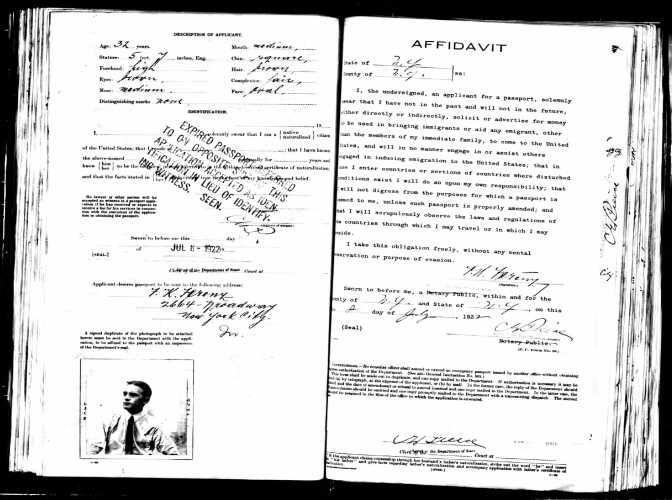
By 1922, Ferenz was selling craft that he purchased in Europe. Was he introduced to Nazism on a buying trip? Possibly. A 1922 passport application records his intention to visit Frg where, from 1920-23, Hitler spoke often. If Ferenz did not see Hitler in action immediate, however, maybe he heard about him from his sis-in-law, "a member of the Nazi undercover movement in Vienna."
It is unclear what acquired Ferenz to leave New York for L.A., but in 1928 he opened the Los Angeles Academy of Modernistic Art; and in January 1929 he attended Mrs. Frank C. Walmsley's "Salon of Ultra Modern Art" in Hollywood, where Rudolf K. Schindler was the speaker.
Either Ferenz was not yet the fanatical anti-Semite he would become, or he was too much of an opportunist to snub the Jewish architects, and boyfriend Viennese expats, Schindler and Neutra, who were and then sharing Schindler'southward Due west Hollywood home.
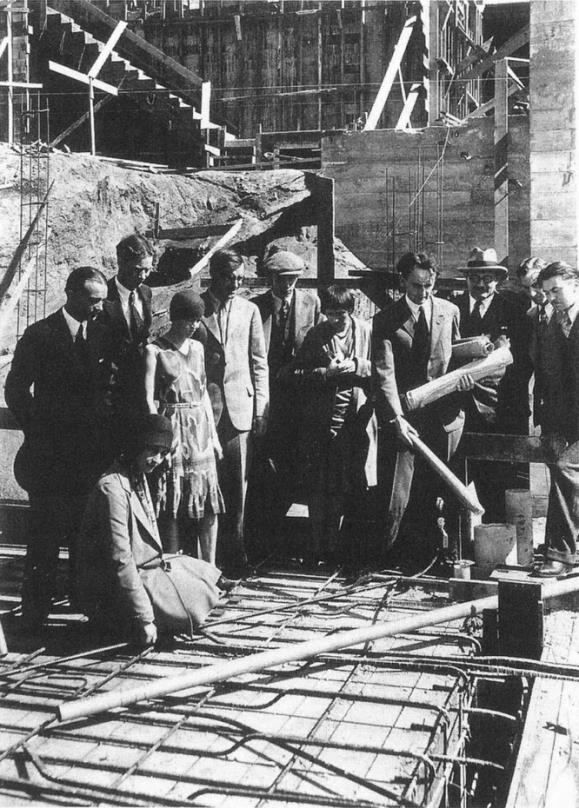
On Jan. 31, 1929, Neutra began teaching at Ferenz's University. His "Practical Class in Modernistic Building Art" was organized effectually the Lovell House construction. Likely the first steel-framed abode in America, the Lovell House would, writes Esther McCoy, participate "in the legend of the mod movement in Southern California."
A photograph of Neutra's class visiting the Lovell construction site suggests that it besides had an impact. Like a snapshot of the moment when a stone hits the pond, the prototype shows Neutra gesturing toward reinforcing confined. Futurity architects Gregory Ain and Harwell Harris stand beside him. Annita Delano, who will influence generations of artists over a 40-year UCLA career, is on his right. Barbara Morgan, who will cofound the anti-fascist American Artists' Congress in 1936, is kneeling. A dark-suited man with centre-parted hair stands backside Morgan. This is Ferenz.
In October 1931, Neutra spoke on "New Compages" at Ferenz'southward new space, the Plaza Fine art Center (PAC), in conjunction with an exhibition curated by Pauline Thou. Schindler, estranged wife of the architect. Occupying the second floor of Olvera Street's Italian Hall, the PAC was part of Christine Sterling'south endeavour to transform "one of the dingiest parts of the downtown commune into a picturesque and colorful Mexican market." It would, said the 50.A. Times, include galleries, a iii-branch of Ferenz's Academy and a society offering "tango teas." In addition, R.M. Schindler would remodel the shops.
Although Schindler's remodel never materialized, the PAC opened on Sept. ane, 1931, with L.A.'s first large exhibition of contemporary Mexican paintings. Curated past artist Juan Crespo de la Serna, information technology presented 135 works by 28 artists, including David Alfaro Siqueiros.
Siqueiros himself arrived in Los Angeles in 1932. His commencement mural in the city, "Street Coming together" at Chouinard Art Institute, provoked controversy for its egalitarian delineation of Black and white workers. Eager for the publicity that a second mural would generate but concerned about Siqueiros's politics, Ferenz and Sterling commissioned "América Tropical." As Siqueiros noted at the fourth dimension: "It has been asked that I paint something related to tropical America, possibly thinking that this new theme would give no margin to create a piece of work of revolutionary graphic symbol. On the contrary, it seems to [me] that there couldn't be a better theme to use."
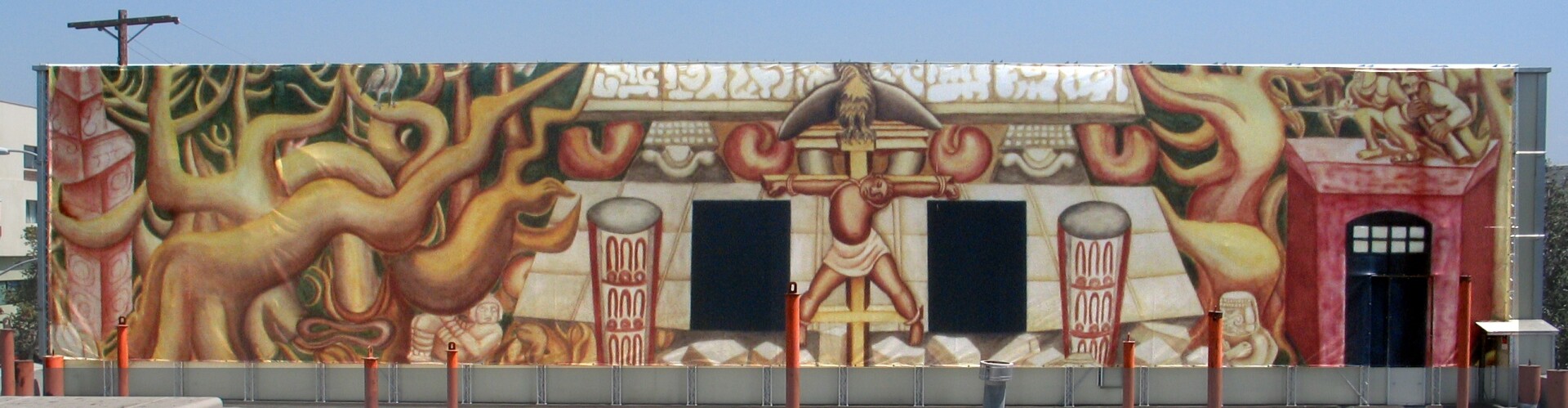
With little money available, Ferenz secured donations and loans of materials and tools, including scaffolding, cement and industrial spray guns. With their help, América Tropical was revolutionary in both course and content. At its October 1932 unveiling, where Ferenz introduced the creative person, the audience gasped at Siqueiros's image of a crucified Ethnic worker, a screaming eagle on top of the cross and crouching snipers aiming at the bird.
An indictment of U.S. imperialism that also promised retaliation, the landscape developed an iconography of "Indianism…removed from picturesqueness" that was new to U.S. eyes. In addition, Siqueiros' experimental use of spray guns to utilize paint to moisture cement, and his approach to dynamic spatial movement led the way toward a hereafter of muralism that continues to unfold today.
For PAC teacher Lorser Feitelson, "América Tropical" "made everything else…expect like candy box illustrations." For Sterling, who wanted a candy box, the mural had to become. Ferenz may take been more ambivalent. Forced to paint over the surface area visible from Olvera Street, he "saw to it that a harmless covering was used."
In January 1933, Adolf Hitler became Chancellor of Germany and Ferenz became managing director of the Hollywood Fine art Center (HAC) (This was not the same institution every bit the Hollywood Art Middle, which was directed by Henry Lovins). The two events announced unrelated until, on May seven, 1933, the HAC hosted Dr. Konrad Burchardi, a local physician, eugenicist and future author of L.A. Times commodity "Why Hitler Says Sterilize the Unfit," who gave a lecture in German on Deutschland's political state of affairs. Southward. McClatchie spoke on "Germany's Resurrection" on June 14, and ane-week later Jewish doc Dr. F. J. Gassman spoke on "The Jewish Question in Germany."
Couching Hitler'southward efforts to systematically remove what he chosen "the cancer of democracy" equally a "resurrection," McClatchie's talk would almost certainly have praised new laws that let the Nazi government act without parliamentary approval (March 23, 1933); fired Jews and political opponents from government employment (Apr 7, 1933); abolished merchandise unions and collective bargaining and saw union leaders imprisoned in the new Dachau concentration military camp (May 2, 1933). Presumably less evangelical than McClatchie, Dr. Frederick Gassman'south talk may well have attracted some of the 12,000+ demonstrators who gathered in downtown L.A. on March 29, 1933 to protest anti-Jewish violence in Germany.
Just Ferenz'due south abrupt turn from art to politics was not the work of an impresario looking to grow his audience; it was a product of his accented support for the Third Reich.
Janet Owen Driggs
American public interest in High german affairs was loftier in 1933, merely Ferenz's abrupt turn from art to politics was not the piece of work of an impresario looking to grow his audience; it was a production of his absolute back up for the 3rd Reich. From mid-1933 when he publicly hatched as a Nazi, to early 1942 when he was jailed for sedition, Franz M. Ferenz'south "every activeness was directed toward the promotion of Hitler and Nazi Deutschland."
In 1934 for instance, he published "Hitler – What Every American Should Know Near the Man Whose Influence is Felt the World Over." He sold the swastika-embellished book at his new venue, the Continental Bookstore on W 7th Street, alongside pro-Nazi literature, records, and bronze relief plaques of Hitler. Ane such plaque hung in a black velvet shrine in the lobby of the Continental Cinema, which Ferenz opened on 24th Street in 1936. Today, the building is home to the Velaslavasay Panorama, merely 75 years ago, incoming patrons customarily gave the Hitler salute, which Ferenz would return.
Every bit Steven J. Ross describes in "Hitler in Los Angeles" (2017), the Continental and other theaters managed by Ferenz offered Hitler-supporting Angelenos "an exuberant participatory feel." Audiences cheered the latest Nazi films and newsreels, sang Nazi songs and allow their anti-Semitic feelings rip. Following a scene in "Kosher Slaughter" (1938) for example, in which a steer is ritually slaughtered, several patrons shrieked: "Allow's do the same thing to the Jews."
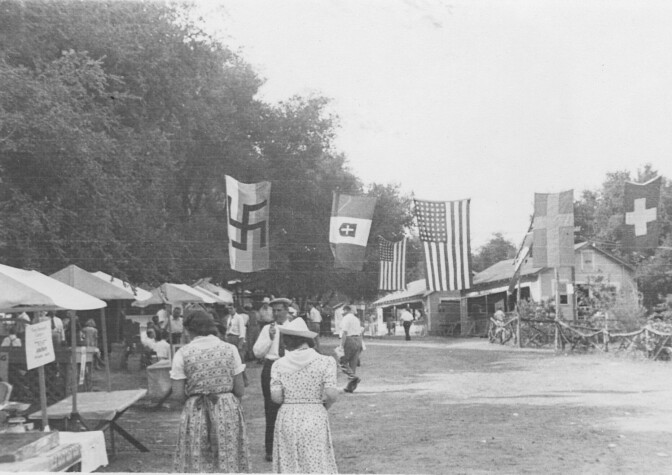
Ferenz apace became the Nazi's principal Due west Declension propaganda distributor. He also lectured, wrote letters to the press, co-produced an annual Swastika-draped picnic in Hindenburg Park, staged a mock-impeachment trial of President Roosevelt and expert bullying and intimidation.
In March 1941, for example, an amateur spy network led by Jewish attorney Leon Lewis reported that Ferenz was trying to stop adult education teacher Sam Evans exposing Nazi propaganda tactics to his students. When heckling his classes failed to silence Evans, Ferenz and 75 associates made what the L.A. Times described equally "a cauldron of dissonance" at a Board of Educational activity meeting demanding Evans' immediate dismissal. Requesting a constabulary escort, Mr. Evans said, "this is simply the beginning of Mr. Hitler'south trying to reach his long arm into Los Angeles."
Although enemy tanks never rolled along its boulevards, Los Angeles was a key World State of war II battleground. In addition to hosting the Hollywood propaganda machine that could sway U.S public opinion and continue America out of the state of war, Los Angeles was a major shipping manufacturer that provided the U.S. Pacific Fleet with its home port. Add in the anti-Semites who already called California dwelling house, and from Berlin's perspective Los Angeles was the perfect locus for subversion.
Ferenz's public works made him a useful Nazi tool in the battle for Los Angeles, but it was his clandestine activities that almost turned him into a deadly weapon. With U.S. authorities paying scant attention to pro-Nazi circles in the years before Pearl Harbor, it was a Lewis spy who exposed a grisly plot to execute 20 well-known Angelenos, including choreographer Busby Berkley and Lewis himself. Timed for New Year'south Eve 1935, the simultaneous murders were meant to provoke a nationwide pogrom against Jews. The chief plotter stated: "Berkley will expect expert dangling on a rope'due south end." It is across doubt that Ferenz, one of the intended executioners, agreed.
This plot and others unraveled due to the work of Leon Lewis and his spy network, but Ferenz continued to scheme until 1942, when he was imprisoned in San Quentin for violating land anti-subversion laws. He was released in June 1945 afterwards an appeals court ruled there was insufficient evidence he had advocated violent overthrow of the regime. Returning to his MacArthur Park shop, Ferenz sold phonograph records with his new wife Dorothy until he died in 1956.
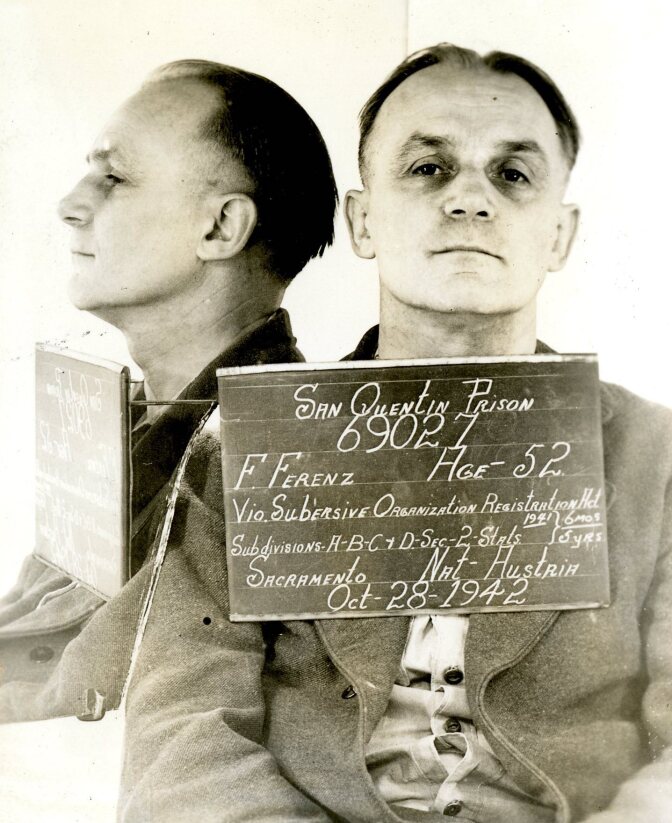
Today Ferenz has largely been forgotten. Occasionally he is named as commissioner of "América Tropical," less frequently he is besides identified as a future Nazi propagandist. But the extent to which he was instrumental in furthering first modernist and and then fascist ideas in Los Angeles has not yet been identified.
Reporting on Ferenz'south 1942 trial, the Los Angeles Daily News stated that "Mrs. Pauline South. Schindler of Los Angeles, testified she in one case refused to shake hands with Ferenz in a Los Angeles theater on grounds he was a Nazi agent." Records suggest that the witness was Pauline (Sophie) One thousand. Schindler. Perhaps, similar the outspoken, left-leaning Mrs. Schindler, the 50.A. artworld has turned its figurative back on the odious Ferenz for the by 70 years?
That art histories of L.A. have diminished a Hitler-loving supporter of genocide to the signal of erasure is not necessarily a bad affair. But recent political events indicate that now is the fourth dimension to remember exactly how, and how far, a fascist could permeate even the allegedly liberal realm of modern fine art in the run up to World War II.
Editor'due south Note: Readers may associate fascist Ferenz'southward HAC with that of the Jewish Henry Lovins, who ran an system of the same name for decades, and who owned copyright to the proper name. A clarifying sentence was added Nov. xv, 2021 to make a distinction betwixt Ferenz's and Lovins' HACs.
frizzellromse1997.blogspot.com
Source: https://www.kcet.org/shows/artbound/franz-ferenz-how-a-nazi-infiltrated-l-a-s-1930s-art-scene
0 Response to "New York Times Extra Serving Bread Arts Craft Germany Nazi Camp"
Post a Comment