The Art of 3d Computer Animation and Effects 3rd Ed Google Doc
Oh man, is this book beautiful! Just browsing through the 500+ total-color images in The Art of 3D Calculator Animation and Furnishings reminds me of why I entered the field of figurer games and graphics in the first place.
Author Isaac Kerlow evidently loves his work, and put a lot of that dear and what he knows from his position, as Director of Digital Production at the Los Angeles offices of The Walt Disney Company, into this book. (Incidentally, the company where one of my figurer graphics students also now holds a position.)
It's rare that I'll read a book cover-to-cover twice in the aforementioned week, but to absorb the amount of detail that is Fine art of 3D pretty much requires it. I also kept getting distracted by the pictures. Each page carries and so much eye-processed and brain-candy it'south like reading through an encyclopedia. You go in looking for ane affair and wind upward reading most something completely unrelated. Okay, so I'm a graphics geek and I'm geeking out on this volume. Information technology'southward the kind of book you simply must geek out besides. Did I mention the pictures already? All of the information and techniques presented are accompanied by a copious number of full-colour images covering the last 50 years of computer animation. Fine art of 3D introduces many of the concepts that were pioneered in the pre-digital days and brings them right up to date.
 |  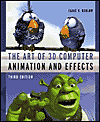 Title: The Fine art of 3D Reckoner Blitheness and Furnishings, 3rd edition Rating (out of 5): Pros
Cons
|  | ||
 | ||||
 | ||||

Art of 3D should ideally be read cover-to-cover, though each section stands solitary and tin be read in a unmarried sitting. Much of the material is taught in a semi-tutorial manner, remaining platform- and software-doubter, but presented in a manner that lets you follow along whilst at your calculator. There are simply a few images from various software packages included to illustrate a particular point.
Information technology's quite obvious Kerlow is a visual thinker and a great believer in lists. There are lists of team breakdowns, lists of standard software packages, lists of light source types—lists for everything. He even illustrates his lists with images.
Each section opens with a summary of what will be covered, jumps right into deep stop of the material with appropriate images and illustrations, and finally wraps upwards with a list of terminology and points covered. The list is presented as bullet points to assistance you in remembering the central items that were covered. Many sections also wrap upwardly with a "Getting Started" piece for readers who are non sure how to arroyo the subject.
I've worked with quite a few art directors and game designers (every bit well equally other programmers) who are incredibly talented and competent in their fields, only can occasionally lack the terminology for basic things such every bit camera motion or types of lights, and it then falls to me to doodle very poor illustrations on a whiteboard to explain my thought visually. I'll be referring to Art of 3D a lot more than when attempting this, every bit the simple comic-book panels illustrate fundamental points perfectly. It'south non often yous meet the concept of ray-tracing explained using a pig in a top hat, a gopher holding a beer, and a strangely drawn human holding a daiquiri with an umbrella in it. I possess an unabridged shelf of books on cinematography techniques, and few are as succinct or clearly illustrated as the section in Art of 3D, using a wide eyed squealer holding a Martini drinking glass to illustrate the use of differing lenses, or dangling from badly knotted cord for the time-freeze (a.k.a. bullet-time) effect.
Art of 3D really covers a lot of ground for the approximately 450 pages—everything from planning, workflow, product and personnel, through modeling, texturing, and lighting, correct up to rendering "hacks" that modern studios will adopt to make sure they render all of the frames inside the time constraints of a production schedule.
Though Art of 3D is aimed primarily at beginning to intermediate reckoner graphic artists, I think that many designers, programmers, and seasoned artists could really learn a lot from this volume. Y'all would need to spend years practicing traditional animation, estimator graphics, stage lighting, cinematography, and many other techniques to know even a quarter of what's covered in this volume. While Art of 3D doesn't profess to exist an encyclopedic handling of all these subjects, information technology does manage to give a expert grounding in the small amount of infinite bachelor to each department. The techniques and terminology I teach on my DirectX graphics courses are covered in brilliant detail and I'll certainly be introducing this book every bit recommended reading. Expect to see the 4 th Edition of this volume in a few years time with all of the great visual furnishings that were pioneered in the Lord of the Rings trilogy.
frizzellromse1997.blogspot.com
Source: https://www.gamedeveloper.com/art/book-review-the-art-of-3d-computer-animation-and-effects-3rd-ed
0 Response to "The Art of 3d Computer Animation and Effects 3rd Ed Google Doc"
Post a Comment